How to Automate AWS Startup and Shutdown: Setup Procedures, Selection Guide, and Points to Note
- aws
- Amazon EC2
- Operation automation



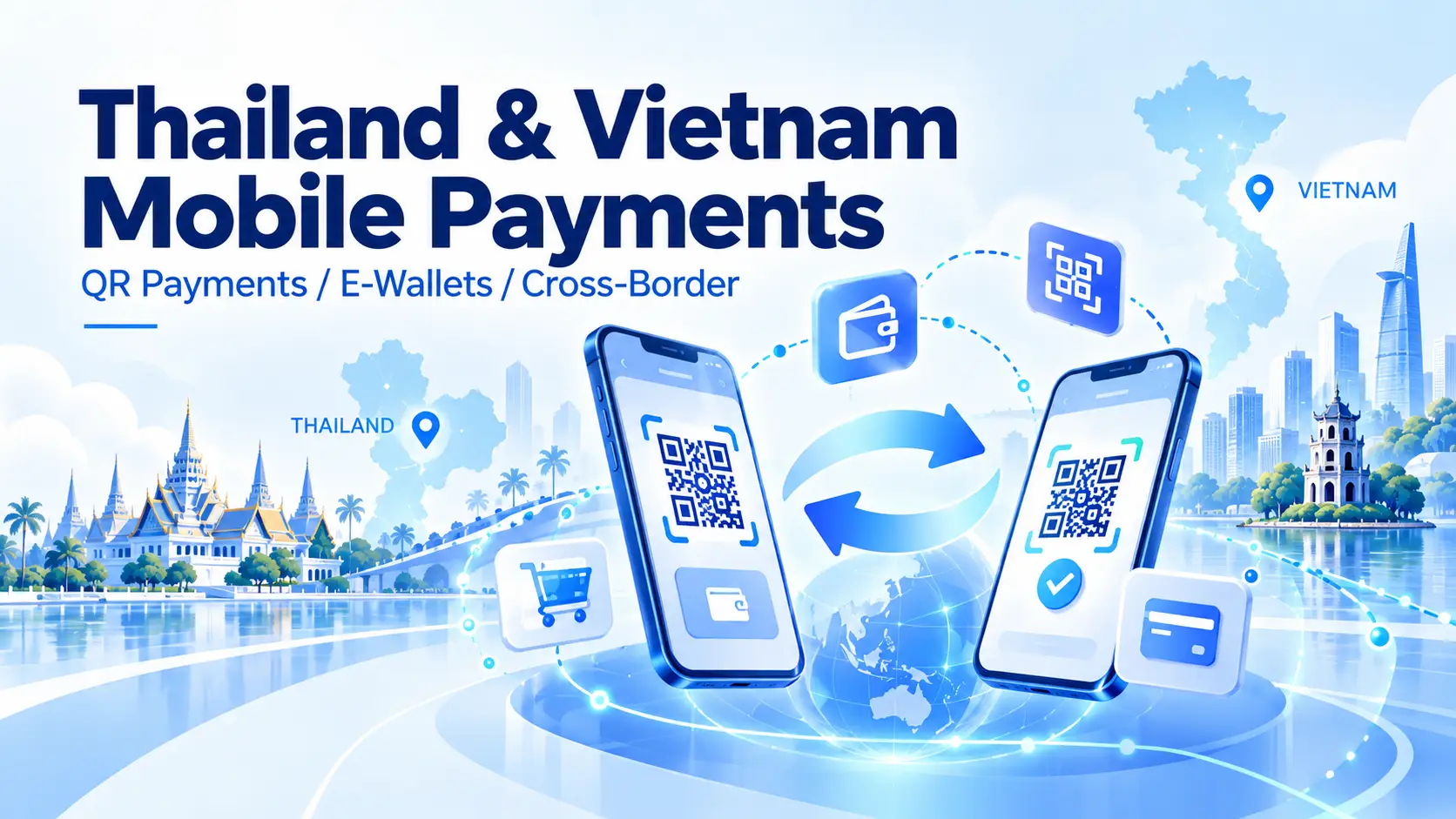
In Thailand and Vietnam, QR code payments and mobile wallets are used daily and have become widespread in a variety of settings, including restaurants, retail stores, and e-commerce. In recent years, cross-border QR code payment integration has also progressed, allowing payments to be made from domestic bank apps and other services overseas.
This article summarizes the characteristics and usage of major mobile payment methods used in both countries, and explains their impact on stores, e-commerce, and business systems.
Bank of Thailand's 2025 Annual ReportAccording to reports, PromptPay has reached 92.1 million registered IDs and an average of 74.6 million daily transfers. VietQR is also expanding in Vietnam, with approximately 90 million mobile banking accounts using it by October 2025.
There are mainly two types of mobile payments:
QR payment
This method involves scanning a QR code at a store or other location with a banking app and paying directly from your bank account. Thai QR Payment in Thailand and VietQR in Vietnam are typical examples.
Mobile wallet
This service requires users to register their bank accounts, cards, and other information through a dedicated app. Examples include TrueMoney in Thailand, and MoMo and ZaloPay in Vietnam.
In Thailand, in addition to QR code payments using PromptPay, mobile wallets such as TrueMoney are also used.
PromptPay is a payment infrastructure promoted by the Bank of Thailand, which launched in 2016. It allows users to link their bank account to their mobile phone number or national ID, enabling them to send money without having to enter their account number.
The store uses Thai QR Payment via the PromptPay system. Customers scan the store's QR code with their mobile banking app and pay from their bank account.
The ease of implementation is a key factor in the widespread adoption of Thai QR Payment, even among small businesses. It uses a common standard that can be used across banks and payment services, and businesses can accept payments even with printed QR codes. Because it doesn't require specialized equipment like card payment terminals, it's an easy system to implement in restaurants, food stalls, and other similar establishments.
Related article: A life without a wallet in Vietnam: How QR code payments have changed daily life
TrueMoney is a mobile wallet that can be used for QR code payments at stores, as well as for money transfers, utility bill payments, and online shopping. In 2026, it will also launch Tap-to-Pay for contactless payments, expanding its payment methods beyond QR codes.
The differences between PromptPay and TrueMoney are as follows:
Item | PromptPay | TrueMoney |
Types | Bank account-based payment and remittance infrastructure | Mobile wallet |
Main usage | Pay and send money by scanning a QR code with your banking app. | Make payments and send money via the TrueMoney app. |
Funding base | Bank accounts | Wallet balance, bank account, etc. |
Main uses | Person-to-person money transfers, QR code payments at stores | In-store payments, online payments, money transfers, utility bill payments, etc. |
Characteristics | Widely used as an interbank settlement infrastructure in Thailand | You can use multiple payment and financial services with a single app. |
Typical payment methods | Thai QR Payment | QR code payments, online payments, tap-to-pay, etc. |
Typical payment methods include VietQR, which is based on bank accounts, as well as mobile wallets such as MoMo and ZaloPay.
VietQR is a common QR code brand developed by the Vietnam National Payments Corporation (NAPAS) and banks. It standardizes specifications across banks and payment services, enabling QR code-based money transfers and payments even between different banks.
Users scan QR codes with banking apps and make transfers and payments from their bank accounts. VietQRPay is also available for businesses.
From January to October 2025NAPASThe number of VietQR transfers processed by the network reached 36 billion, representing an increase of over 52% in the number of transactions and 85% in the amount compared to the same period last year. Its use is expanding not only to large retail stores but also to markets, street food stalls, parking lots, and other locations.
MoMo is a mobile wallet that allows you to make payments at stores and online, pay various bills, and access financial services through its app. ZaloPay also supports payments at stores and online, money transfers, and utility bill payments.
In addition, VNPAY-QR, which allows payments via QR code from mobile banking apps of multiple banks, is also being used.
In Thailand and Vietnam,Interoperability of QR payment systems in March 2021It began as a pilot project, and the official opening ceremony was held in November 2022.
Using compatible banking apps, people visiting Vietnam from Thailand can pay with VietQR locally, and people visiting Thailand from Vietnam can use Thai QR Payment. Since you can use your usual banking app overseas, it reduces the hassle of registering a new payment app in your destination country.
These initiatives are part of "ASEAN Payment Connectivity," which connects payment systems across ASEAN countries. In Thailand, QR payment partnerships are progressing not only with Vietnam but also with Singapore, Malaysia, Indonesia, Cambodia, and other countries. In 2025, a service was launched that would allow payments from China's Alipay, UnionPay, and WeChat Pay to Thai QR in Thailand.
Companies operating physical stores or e-commerce sites locally need to consider not only how to handle payment methods, but also how to integrate them with sales data and accounting processes.
When selling goods or services, in addition to credit cards, you should also consider supporting locally used payment methods such as PromptPay, VietQR, and mobile wallets.
In physical stores, POS systems can be integrated with payment services, and in e-commerce, multiple payment methods can be offered through payment processing services.
QR code payments are expanding beyond simply accepting payments to include integration with business systems such as sales management.
In August 2026, Vietnam announced a partnership between NAPAS and the sales management platform KiotViet to deploy VietQRPay into their sales management systems. By linking order information and payment amounts for each transaction, it will be possible to manage sales confirmation, payment reconciliation, refunds, and cancellations.
When implementing multiple payment services, it's necessary to decide how to manage sales and payments, taking into account differences in payment dates, fees, and data formats.
Mobile payments may involve handling customer information in addition to transaction information. It is necessary to organize the data held by your company and properly manage access permissions and storage methods.
When handling personal information, we also check the personal data protection systems of Thailand and Vietnam.
What's noteworthy about mobile payments in both countries isn't simply the increasing trend towards cashless transactions. The widespread adoption is supported by the QR code payment system, which can be used across banks and services, and an environment that makes it easy for even small businesses to implement.
Payment processes are evolving beyond simple payment transactions, becoming integrated into systems that connect to sales and revenue management. For companies operating locally, the choice of payment methods is a crucial issue not only for customer convenience but also for the design of their business systems.