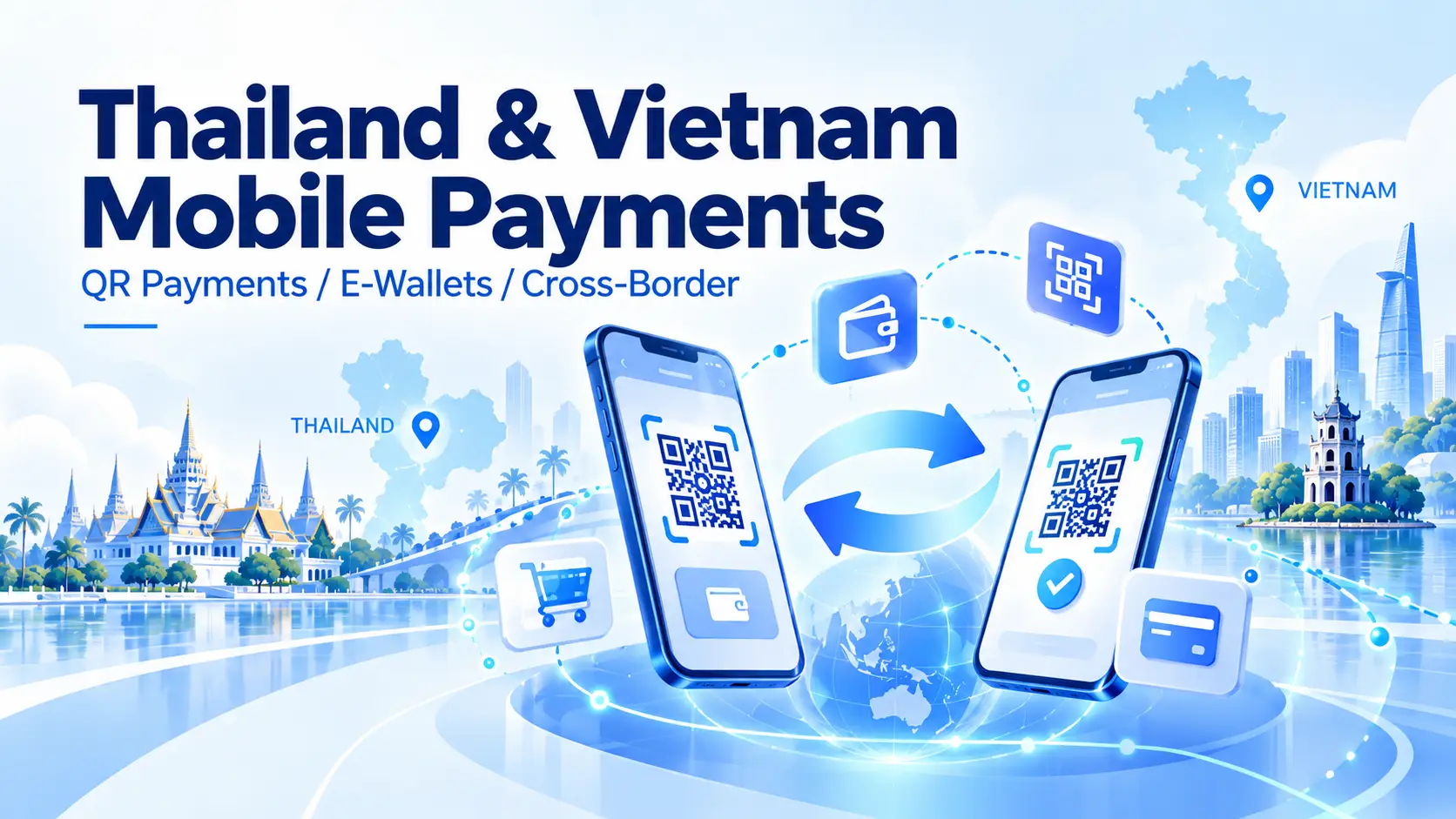
What is mobile payment, which is becoming widespread in Thailand and Vietnam? An explanation of its impact on corporate systems.
- Vietnam
- Thailand


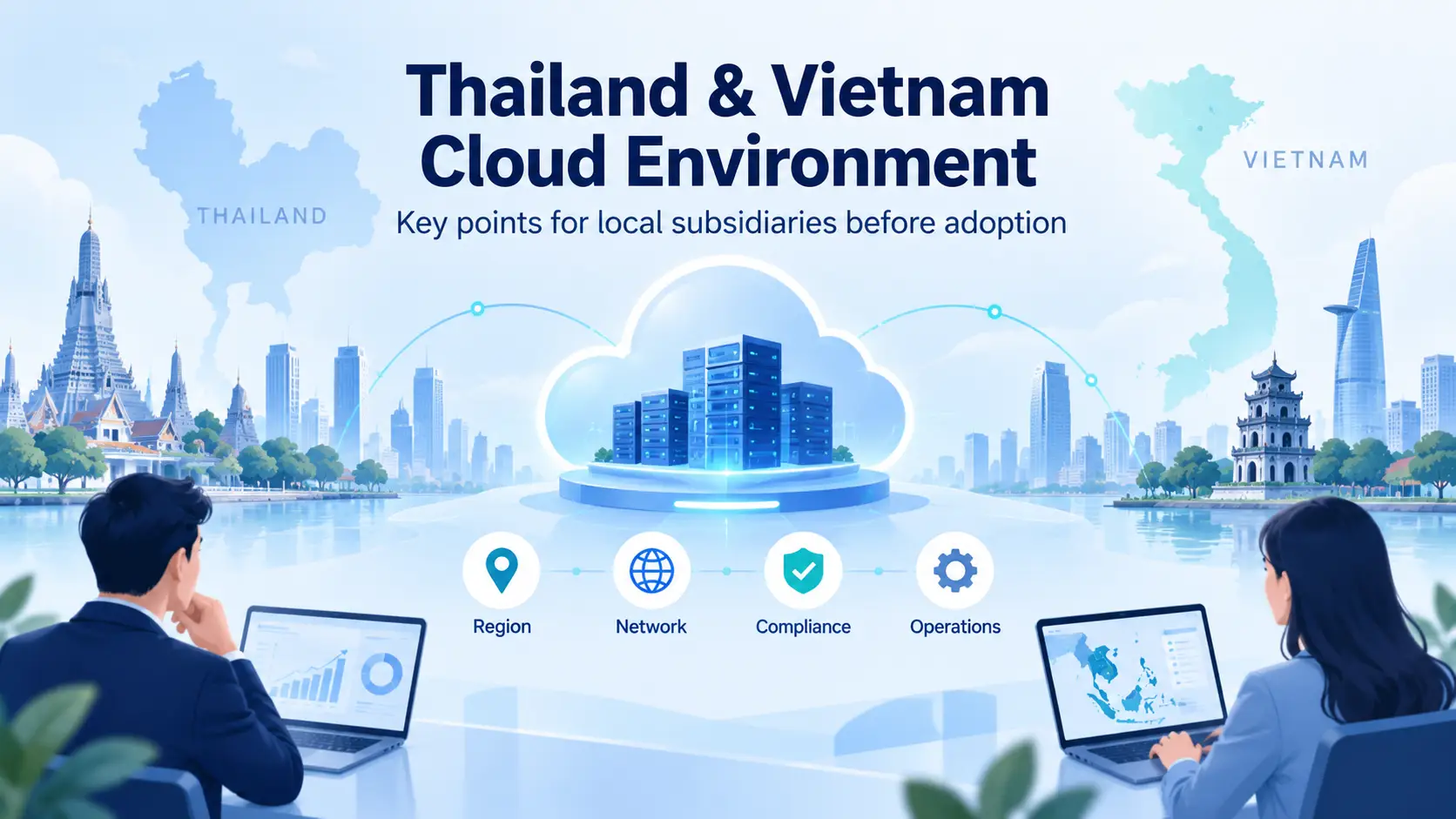
While Thailand and Vietnam offer a wider range of cloud service options, the available regions, network environments, and data regulations are not the same. Therefore, the configuration used at our Japanese headquarters needs to be reviewed to suit local conditions.
For example, in Thailand, you can use domestic regions of AWS and Google Cloud. On the other hand, in Vietnam, a configuration that combines AWS Hanoi Local Zone, domestic clouds, and overseas regions such as Singapore is also an option.
This article summarizes the differences in cloud usage environments between Thailand and Vietnam, and explains key points to consider before implementation, such as data storage and international transfer, services used, communication routes, and the division of operational responsibilities between headquarters and local subsidiaries.
In Thailand, major cloud providers are successively opening domestic regions. While Vietnam is also making progress in developing its cloud infrastructure, there are differences in the available environment and options compared to Thailand.
AWS announced that in January 2025, the AWS Asia Pacific (Thailand) Region (ap-southeast-7) General availability beginsWe have launched it. It is the first AWS region in Thailand and consists of three Availability Zones (AZs).Google Cloud will also be expanding to the Bangkok region in January 2026.asia-southeast3) opened
In terms of networking, AWS Direct Connect is available at the TCC Data Center and Telehouse Bangkok in Bangkok. This provides a choice of configurations, including dedicated connections to AWS as well as connections via the public internet.
Companies that previously used Tokyo or Singapore regions can now deploy their Thai subsidiary's system domestically.
However, simply migrating existing systems to the Thailand region isn't always the best solution. You should compare available services, pricing, connectivity with existing systems, backups, and disaster recovery (DR) options before making a decision.
AWS will launch an AWS Local Zone in Hanoi in June 2026.ap-southeast-1-han-1a) General availability beginsYes, this is not a new AWS region being established in Vietnam, but rather a mechanism that extends some AWS services closer to users, using the Singapore region as the parent region.
In December 2025, the first AWS Direct Connect location in Vietnam will also open at the CMC Tower in Hanoi.It was done.
Within Vietnam, there are also services such as Viettel Cloud, FPT Cloud, and CMC Cloud. FPT Cloud utilizes data centers in Hanoi and Ho Chi Minh City, while CMC Cloud supports connections to AWS, Google Cloud, and Microsoft Cloud.
In Vietnam, a configuration that utilizes overseas regions, AWS Local Zones, domestic clouds, data centers, and on-premises environments depending on the application is also an option.
On the other hand, increasing the infrastructure also complicates the configuration and operation. Because there are limitations to the services provided by AWS Local Zone, it is essential to design the system including where the processing will be located and who will operate it.
Related article:What is the AWS Thailand Region? We explain the differences from Singapore and how to choose the right one for you.
When selecting a cloud service, factors to consider include not only the region and services, but also local data protection and rules regarding data transfer abroad.
In Thailand, the Personal Data Protection Act BE 2562 (2019), commonly known as the PDPA, applies to the handling of personal data. However, this is not a system that uniformly mandates that all personal data be stored within Thailand.
When transferring personal data overseas, the level of data protection and transfer methods at the destination are considered in accordance with Articles 28 and 29 of the PDPA. If an adequate level of protection is not deemed to be present, mechanisms are in place to utilize protective measures such as Binding Corporate Rules (BCR) and Standard Contractual Clauses (SCC).
In Vietnam, the Personal Data Protection Law (Law No. 91/2025/QH15) and Decree No. 356/2025/ND-CP came into effect on January 1, 2026. It is necessary to comply with the current regulations rather than relying solely on the previous Decree No. 13/2023/ND-CP.
Under the new Personal Data Protection Law, "cross-border transfers" now include not only cases where personal data collected within Vietnam is moved to servers outside the country, but also cases where it is processed on platforms outside the country. In principle, businesses that conduct cross-border transfers are required to prepare and submit impact assessment documents, so the use of Singapore's cloud region or overseas SaaS will also be subject to review.
Law on Data No. 60/2024/QH15 and Decision No. 20/2025/QD-TTg also define the distinction between "important data" and "core data." The rules that apply vary depending on the data being handled, so it cannot be determined solely by the server's location.
When deciding on a cloud configuration, it's important to understand the data storage, transfer destination, and processing responsibilities, including backups, logs, transfers to the Japanese headquarters, and access from overseas.
Please note that laws and guidelines are subject to change and revisions. Therefore, when deciding on your actual cloud configuration, be sure to check the latest information and consult with your company's legal and security personnel, as well as experts, if necessary.
Even if the Japanese headquarters has standardized on AWS, Microsoft Azure, etc., local subsidiaries may need to revise their configurations. This is because the services offered differ by region, and network, data storage requirements, and the scope of support from local vendors also vary.
For example, a Thai company that has previously used the AWS Singapore region will now also consider domestic deployments as a point of comparison after the opening of the Thailand region.
In the Hanoi Local Zone in Vietnam, services such as Amazon EC2, Amazon S3, Amazon EBS, Amazon ECS, and Amazon EKS are available locally, but not all services from the Singapore region are directly available.
Along with the technical configuration, the management system is also something that needs to be considered. If the head office is unaware of the deployment locations of local systems, if only the local vendor holds cloud accounts and administrator privileges, and if the head office cannot check logs or usage charges, it will be difficult to respond to failures and security incidents.
Account management and security standards are standardized at headquarters, while regional and network settings are adapted to local conditions. This division of roles makes it easier to balance governance and local operations.
Even if the cloud itself is functioning correctly, business operations can be disrupted due to communication environments or management systems. For overseas locations, it's necessary to consider the infrastructure and operations outside of the cloud as well.
When connecting from Vietnam to cloud regions abroad, such as Singapore, the condition of the international network connection affects the usability and stability of business systems.
In Vietnam, failures in submarine cables can slow down international communications, affecting online meetings with headquarters in Japan, VPN connections, and access to overseas cloud services. For more information on the impact of submarine cable failures on communications and countermeasures, please see the related article "What would happen if an undersea cable failure occurred in Vietnam?” explains.
AWS opened a Direct Connect location at CMC Tower in Hanoi in December 2025, and AWS Local Zones became generally available in June 2026. There are now more ways to connect to AWS from within Vietnam.
The level of redundancy in the network connection is determined based on the criticality of the system. Choose a configuration that meets your required availability from options such as Internet VPN, backup lines, and Direct Connect.
In some local subsidiaries in Thailand and Vietnam, there are no dedicated cloud specialists, and PC management, internal networks, business systems, and vendor support are handled by a small number of people. When personnel changes occur, settings and administrator information may not be fully transferred, and the new person in charge may have to start from scratch to understand the IT environment.
The following conditions require attention:
We leave the management of our AWS account entirely to local vendors.
The administrator is using the personal email address of the person in charge.
We cannot access configuration changes or CloudTrail logs from headquarters.
Local departments are contracting for cloud and SaaS services that headquarters is unaware of.
Account information and operational procedures cannot be transferred when the person in charge leaves the company.
Even if they don't surface during normal operation, these management gaps can delay responses when failures or security incidents occur.
Even when outsourcing system construction and operation to local vendors, ensure that headquarters can access and manage accounts, permissions, configurations, logs, and costs. It's also helpful to designate individuals responsible for initial troubleshooting and vendor communication during normal operation to ensure a smoother process.
The following four points should be checked before implementation:
First, we identify the data that will be handled on the cloud and how it will flow.
Does it include personal data of customers or employees?
Where should production data and backups be stored?
Should the local subsidiary send data to the Japanese head office?
Will logs and monitoring data be transferred overseas?
Will operators in countries like Japan have access to the data?
In Thailand, the PDPA is relevant, while in Vietnam, the Personal Data Protection Act and the Data Act are relevant. Before choosing a cloud provider or region, clarify the type of data and its migration path.
In Thailand, options include AWS Asia Pacific (Thailand) Region and Google Cloud Bangkok Region, while in Vietnam, options include AWS Singapore Region, AWS Local Zone Hanoi, Viettel Cloud, FPT Cloud, and CMC Cloud.
During the selection process, identify where the necessary system functions, such as Compute, Database, Object Storage, Backup, Logging, Security, and DR, are available. Comparing regions based on the actual system configuration is more effective than simply looking at region names.
The design also includes the path to the cloud, such as local ISPs, domestic lines, and international lines.
Connection methods include Internet VPN, dedicated connections such as AWS Direct Connect, international dedicated lines, and backup lines. The combination is chosen based on the required availability and impact on business operations.
Additionally, anticipating a scenario where "the cloud is functioning normally but access from the local area is unavailable," defining the scope of responsibility for each party—the cloud provider, the telecommunications carrier, and the local vendor—will make troubleshooting easier in the event of a failure.
We also decide on the division of roles after cloud implementation during the design phase.
Cloud contract
Account and Permission Management
Configuration changes
Monitoring
Troubleshooting
Security Response
Cost confirmation
Contacting local vendors
It's not necessary for the Japanese headquarters to handle everything. Some tasks can be handled more quickly by local subsidiaries or external partners.
On the other hand, if headquarters cannot grasp the configuration, permissions, logs, and usage fees, control will be ineffective. Who operates the system, who monitors the situation, and who makes decisions in case of trouble? If these three points are clear, it becomes less likely for operations to become a black box even when entrusted to local branches.
In Thailand, domestic regions are an option, and in Vietnam, a configuration combining overseas regions and domestic infrastructure can also be considered.
When selecting a cloud solution, we organize data storage and transfer requirements, necessary services, communication paths, and operational structures for each country, and consider a configuration that balances governance at the Japanese headquarters with local operations.
However, it can be difficult for a company to make decisions on its own, considering local laws and regulations, network environments, and available cloud services. Managedex Cloud supports the design, implementation, and operation of cloud services tailored to local conditions in Thailand and Vietnam. If your local subsidiary has issues with its cloud environment,Feel free to contact us.